How a FORTIFIED Roof Lowers Your NC Home Insurance
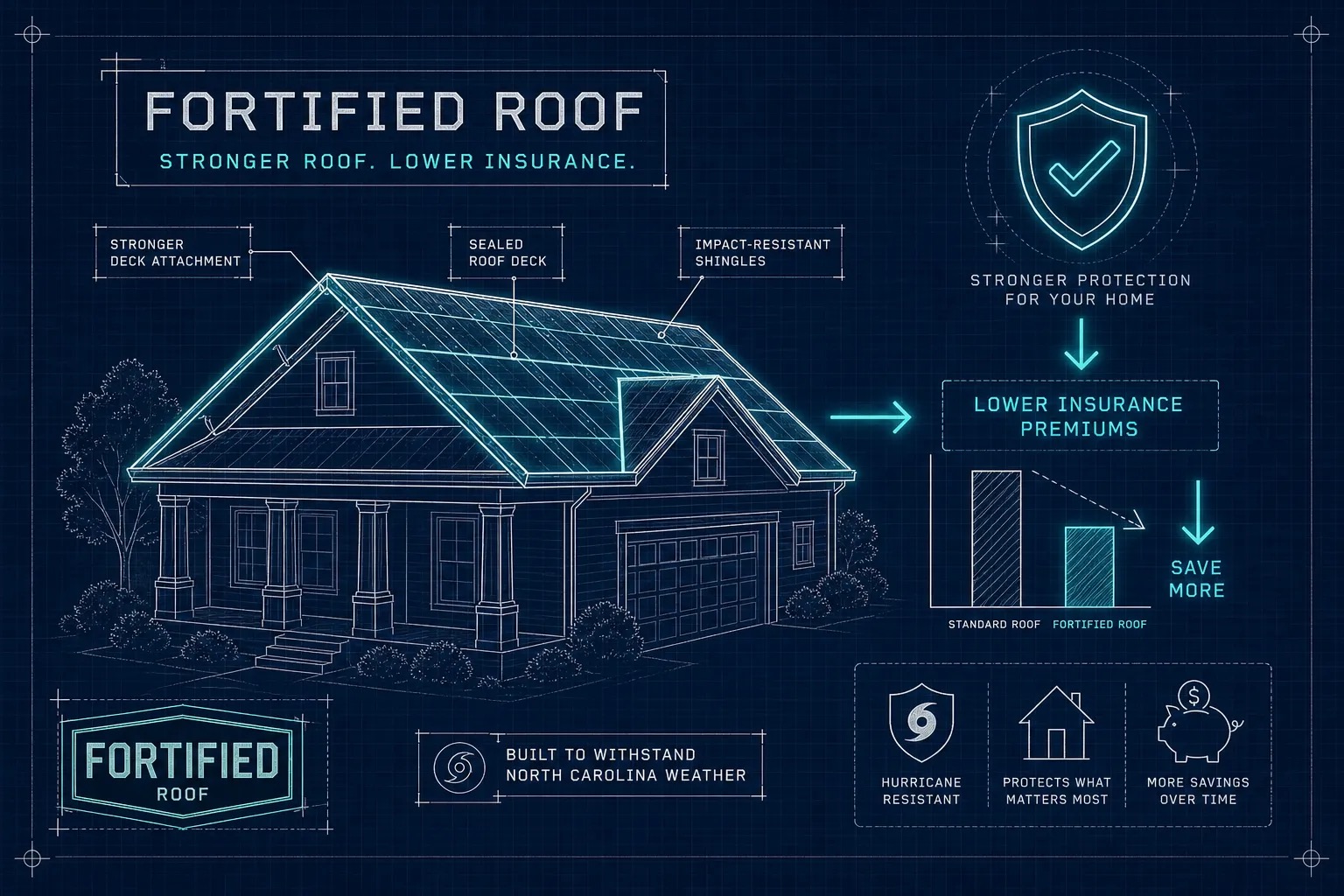
Getting an IBHS FORTIFIED Roof certification qualifies North Carolina homeowners for meaningful premium discounts because participating private insurers treat wind-resistant construction as measurably lower risk. The published credit range from participating private carriers runs about 4 to 6 percent of the wind-and-hail portion of your policy, with total annual savings of up to $700 depending on your location and designation level, according to IBHS. For coastal homeowners in areas like Wilmington and Eastern NC, those savings compound further when state grant programs can cover the entire upgrade cost upfront, making the financial case immediate rather than a decade-long payback calculation.
This article walks through the three FORTIFIED certification levels, what each one means for your policy, realistic dollar figures for both inland and coastal situations, the grant programs available to Beach Plan policyholders, the step-by-step certification process, and the documentation your insurer needs to apply the credit.
Key takeaways
- Right entry point: The FORTIFIED Roof level (formerly called Bronze) requires the fewest changes, qualifies for NC grant programs, and immediately unlocks insurer credits.
- Independent evaluator: An IBHS-certified evaluator, not your contractor, verifies the installation and submits the compliance file to IBHS before the certificate is issued.
- Documentation matters: Your IBHS designation certificate is the primary document your insurer needs, supported by the evaluator’s report, contractor affidavit, permits, and invoices.
What the three FORTIFIED levels mean for your North Carolina policy
IBHS organizes the program into three tiers: FORTIFIED Roof (the former Bronze designation), Silver, and Gold. Each level builds on the previous one, with FORTIFIED Roof focused entirely on hardening the roof system itself. Silver adds whole-home envelope improvements, and Gold is the most comprehensive tier, incorporating opening protection and structural connections throughout the building.
For most North Carolina homeowners, FORTIFIED Roof is the logical starting point. It requires the fewest structural changes, qualifies for the state’s coastal grant programs, and immediately makes a property eligible for premium credits with participating private carriers. It is not an all-or-nothing commitment. You can earn the designation first and pursue higher levels later if your goals change.
At the FORTIFIED Roof level, North Carolina insurers including Nationwide, State Farm, Amica, Farm Bureau Insurance of North Carolina, The Hartford, Travelers, and USAA publish credits of roughly 4 to 6 percent of the wind-and-hail premium, according to North Carolina Sea Grant. Silver and Gold can unlock deeper credits where available, though carrier-by-carrier schedules vary and are not uniformly published across the state.
NCIUA’s Stronger Roof endorsement operates separately from these premium credits. It provides additional coverage of up to $5,000 for FORTIFIED upgrade materials and up to $600 for evaluator costs after a covered roof loss, according to NCIUA’s published endorsement materials. This is not a discount on your current premium; it removes the financial barrier to certifying your next roof after a storm claim.
How much can a FORTIFIED Roof actually save you?
The savings are grounded in real claims performance. Homes with an IBHS FORTIFIED Roof experienced a 73 percent reduction in claim frequency and a 15 percent reduction in claim severity compared with conventionally built homes, according to Roofing Contractor. That track record is what motivates insurers to offer credits in the first place, and it is a meaningful number if you have lived through a coastal storm season.
IBHS reports a maximum of roughly $700 per year with participating private carriers, depending on location and protection level. North Carolina Sea Grant documented one homeowner whose wind-insurance reduction came to slightly more than $90 per year. That gap between the floor and the ceiling illustrates why your specific location and the wind-and-hail share of your premium determine the actual credit far more than any statewide average does.
Inland homeowners should view a certified roof as a resilience investment whose insurance-only payback may take decades.
Are North Carolina coastal homeowners eligible for grants on top of the savings?
NCIUA operates two separate grant programs for eligible Beach Plan policyholders. The Strengthen Your Roof program offers up to $10,000 for properties on the Outer Banks and barrier islands in NCIUA rating territories 110 and 120. The Strengthen Your Coastal Roof program offers up to $6,000 for qualifying properties in 18 coastal counties east of the Intracoastal Waterway, according to the North Carolina Department of Insurance. Both programs are first-come, first-served, and grants cannot exceed the actual cost of the qualifying roof installation.
Eligibility rules are precise. You must hold an active NCIUA Beach Plan policy on the property. Eligible structures include detached single-family homes, duplexes, qualifying townhouse buildings up to three stories, and HUD manufactured homes built after July 1994 placed on a permanent foundation. The completed roof must receive an official IBHS FORTIFIED designation after independent verification. Standard private-insurer policies do not qualify, and NCJUA/FAIR Plan dwelling full-peril policies are excluded.
For Wilmington-area homeowners, the coverage is well-positioned. New Hanover, Brunswick, and Pender counties are all among the 18 qualifying counties for the $6,000 program, according to the North Carolina Department of Insurance. Because the typical incremental upgrade cost runs between $1,600 and $3,700 including verification, according to IBHS, and grants reach up to $6,000, many eligible homeowners in these counties can have their incremental upgrade costs covered by the grant, though you should verify your specific covered expenses with the program before assuming full coverage.
The Strengthen Your Coastal Roof program accepts applications online. You will need your NCIUA policy number, mailing ZIP code, and exterior photographs showing all four sides of the home from ground level to the roofline. Once your application is approved by NCIUA and IBHS, you have 18 months to complete the work and obtain the official designation. Submit early: funding is limited and goes to applicants in the order they qualify.
What the FORTIFIED Roof certification process looks like from start to finish
The certification follows a three-party workflow: your contractor installs the roof to IBHS technical standards, an independent certified evaluator verifies the work, and IBHS reviews the full documentation package before issuing the official designation certificate. Understanding this sequence before construction begins is essential because mistakes discovered at inspection can require costly rework after the fact.
Step 1: Install to IBHS technical standards
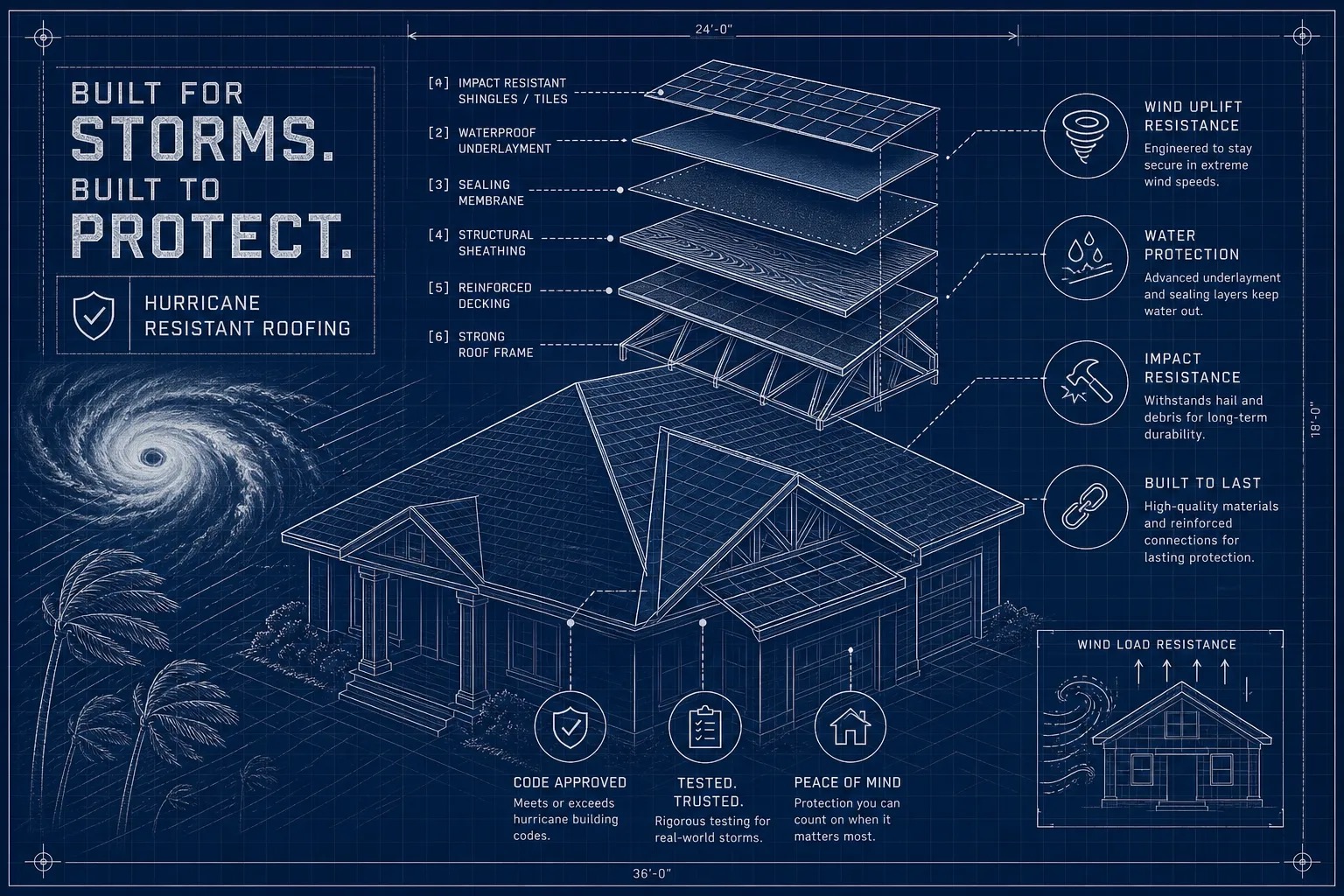
The roof itself must meet IBHS technical standards, which are more demanding than local building code alone. For coastal North Carolina homes under the FORTIFIED Roof Hurricane designation, requirements include sealed roof-deck systems using approved underlayment or seaming methods, roof-deck attachment with 8d ring-shank nails at specified spacing, at least 26-gauge metal drip edge installed over the underlayment, and starter strips set in roofing mastic or self-adhered material at eave and rake edges. Asphalt shingles must carry an ASTM D3161 Class F or ASTM D7158 Class H rating. Properties within the mapped saltwater shoreline zone require corrosion-resistant fasteners and metal components per IBHS Technical Bulletin FH 2021-02.
Step 2: Schedule your independent evaluator
An IBHS-certified evaluator, entirely independent from your contractor, inspects the installation during construction, photographs concealed components before they are covered, documents material certifications, and submits the complete package to IBHS for review. The evaluator is the one party neither you nor your contractor controls, and that independence is exactly why the certificate carries weight with insurers.
Step 3: Receive your IBHS designation certificate
IBHS makes the final determination and issues the certificate after reviewing the evaluator’s compliance file. 50 North Roofing Company installs FORTIFIED Roof systems across Eastern North Carolina.
What paperwork does your insurer need to apply the credit?
The IBHS designation certificate is the core document that activates the premium credit. IBHS issues it after the evaluator submits the compliance file and completes its review. Without this certificate, no credit applies, regardless of what materials were installed or what a contractor attests about the work quality. The certificate is generally valid for five years, after which a redesignation inspection is required.
Most insurers require a full documentation package alongside the certificate. That package typically includes the evaluator’s final inspection report, a contractor completion affidavit confirming the work met IBHS standards, copies of permits and product approvals, and invoices for the installation. Some carriers also require a completed insurer-specific wind mitigation form, with the designation certificate attached as supporting documentation of compliance. Submit everything to your agent in one organized package, and ask specifically for written confirmation of the credit and its effective date, a step homeowners sometimes skip that can cost them a full premium cycle.
Timing varies by carrier; credits typically apply at the next renewal or via mid-term endorsement, so check with your insurer or agent to confirm. Submitting immediately after project completion and before your renewal date is the cleanest path to making sure no premium cycle passes without the credit in place.
Start now, before the next hurricane season
A FORTIFIED Roof designation in North Carolina produces real, documented insurance premium savings through participating private carriers: up to 4 to 6 percent of your wind-and-hail premium, or up to $700 per year, according to IBHS.
The certification process is straightforward when you work with a contractor who understands IBHS standards and coordinates with the evaluator from the start.
Call your insurer or agent to confirm current credit schedules and check your grant eligibility through the NCIUA grant program website. Then get in touch with our team to talk through your roof, grant funds are first-come, first-served, and hurricane season does not wait.
Frequently Asked Questions
How long is the IBHS FORTIFIED designation certificate valid before a redesignation is required?
The designation certificate is generally valid for five years before a redesignation inspection is required. You will need to schedule another independent evaluation and obtain a new certificate after that period if you want to maintain the designation for insurer discounts.
Will the NCIUA Stronger Roof endorsement lower my current insurance premium?
No, the NCIUA Stronger Roof endorsement does not lower your current premium; it provides additional coverage for FORTIFIED upgrade materials (up to $5,000) and evaluator costs (up to $600) after a covered roof loss. That endorsement is meant to remove financial barriers to certifying a replacement roof after a claim, not to act as a premium discount.
If I finish the FORTIFIED upgrade, when will my insurer apply the premium credit?
Credits typically apply at your next renewal or via a mid-term endorsement, depending on the carrier. Submitting your IBHS certificate and the full documentation package immediately after project completion and before your renewal date is the cleanest way to avoid missing a premium cycle.
 Hi! I'm your virtual assistant, here to help assist you navigate www.50northroofing.com!