Hurricane Resistant Roofing: Systems That Actually Work
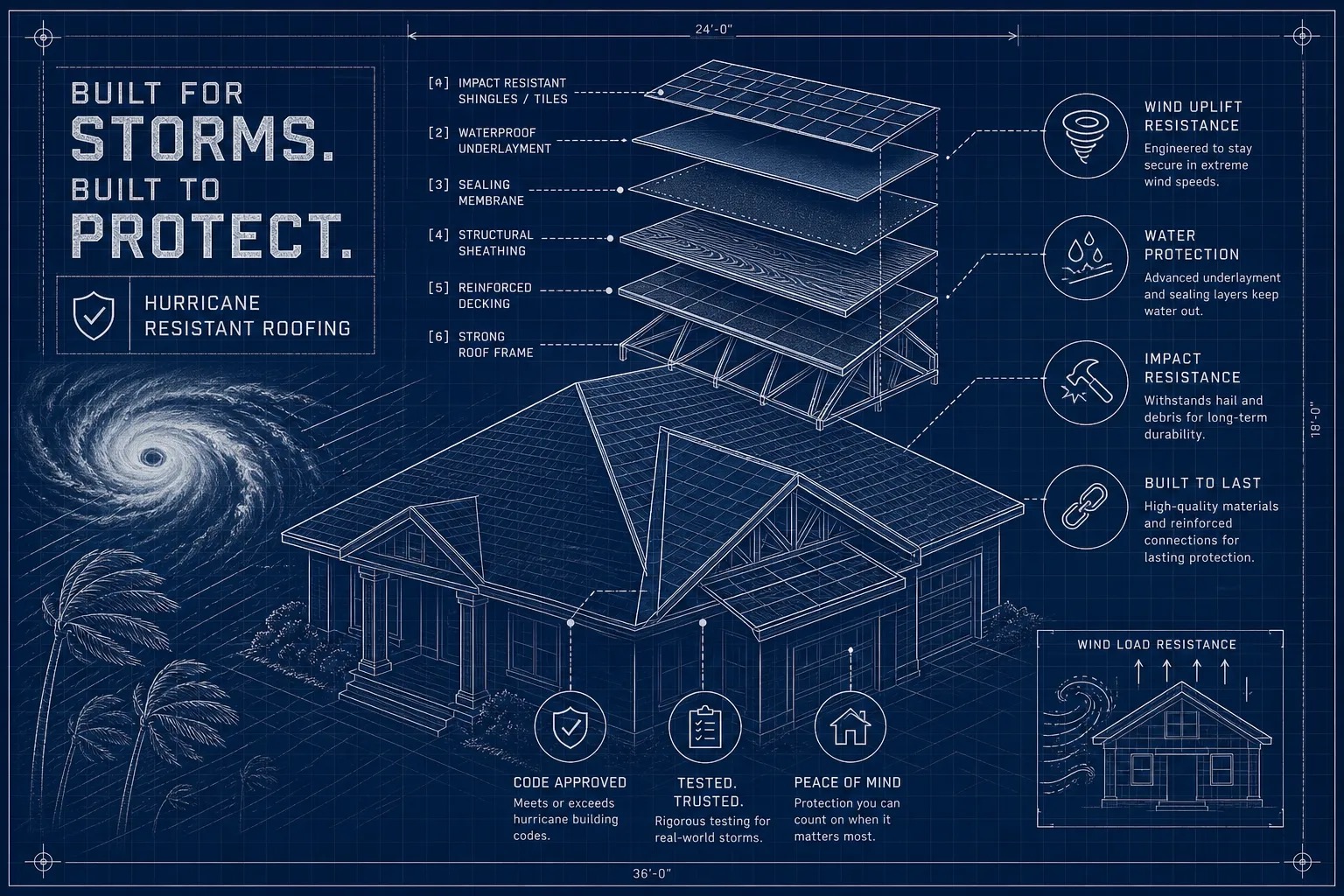
Hurricane resistant roofing depends on the entire assembly, from deck to cover, being rated for the actual design wind pressures at your specific site. No single shingle or panel earns that standard on its own. Standing seam metal leads the category with tested assemblies consistently reaching 140 to 180+ mph under ASTM E1592. Impact-resistant shingles and engineered tile follow, each with real upper limits and strict installation requirements that must be met precisely to reach their rated performance.
“Hurricane-proof” is a marketing claim. “Hurricane-rated assembly” is the standard you should demand from every product, contractor, and approval document on your project. This guide covers what the ratings actually measure, which systems hold up best, what installation details carry the most weight, rough cost ranges for a 2,000-square-foot roof, and what retrofits deliver the best return before the next storm season. For contractors and homeowners along the North Carolina coast, we also cover what to look for when sourcing panels and trim spec’d for the specific uplift demands of eastern NC counties.
Key takeaways
- Assembly, not product: Wind resistance is a property of the complete deck-to-cover system, including fasteners, clips, and edge details, not the panel or shingle alone.
- Standing seam leads: Tested assemblies consistently reach 140 to 180+ mph under ASTM E1592, making it the benchmark system for high-wind coastal zones.
- Load path first: Hurricane straps rated for at least 500 lb uplift capacity, installed at every rafter or truss, are the most critical upgrade on any existing roof.
- Sealed deck matters: A secondary water barrier reduces interior water entry by approximately 95% after the roof covering is damaged, limiting consequential losses in extreme storms.
- Coastal materials degrade: Salt air and humidity can progressively weaken fasteners and clips over 10 to 20 years; corrosion-rated hardware is a spec requirement, not an upgrade.
- NC incentives exist: NCIUA policyholders in qualifying coastal areas may access grants of up to $6,000, with Outer Banks policyholders eligible for up to $8,000, for FORTIFIED Roof certification.
What wind uplift ratings actually mean for your roof
A product approved for a specific design pressure, such as -82.5 psf, does not automatically qualify for every site where the wind speed reaches 180 mph. Exposure category, roof geometry, mean roof height, and your distance from open water all adjust the required pressure your assembly must resist. The only figure that matters for your project is the design pressure calculated for your roof’s field, perimeter, and corner zones at your specific location.
The certification standards that actually count break down by material type. For asphalt shingles, ASTM D7158 Class H is the high-uplift standard, reaching up to roughly 150 mph, while the more commonly cited ASTM D3161 Class F covers only about 110 mph. For metal roof panels, ASTM E1592 evaluates the structural performance of a specific panel profile and clip system under uniform static pressure, not metal panels in general.
Assembly-level approvals add another layer. UL 580 and UL 1897 test uplift of complete roof assemblies, and Miami-Dade Notice of Acceptance remains the most rigorous product approval available, specifying deck type, fastener schedule, underlayment, and maximum design pressure for each approved assembly.
When reviewing any approval document, look past the mph marketing number. Read the approval number, the design pressure in psf, the deck substrate, the fastening pattern, and the perimeter-zone requirements. A roof that satisfies those specifications for your site is a hurricane-rated assembly. Everything else is a starting point for further questions, not a finished answer.
Which roofing systems hold up best in hurricane-force winds?
Standing seam metal is the benchmark for wind-resistant roofing. Tested assemblies consistently reach 140 to 180+ mph under ASTM E1592. Performance comes from the complete panel-and-clip assembly: concealed clips eliminate exposed fastener failure points, and the seam geometry locks panels laterally against uplift.
For coastal zones where salt air and high humidity are ongoing concerns, Galvalume or PVDF-coated panels paired with corrosion-rated hardware are essential. Fastener degradation directly reduces the assembly’s rated uplift capacity over time, so corrosion-rated hardware is a specification requirement for these environments, not an optional upgrade.
Impact-resistant asphalt shingles rated Class H under ASTM D7158 commonly reach 130 to 150 mph. One point worth clarifying: UL 2218 Class 4 is an impact rating focused on hail and debris, not a wind rating. Those are separate certifications, and a Class 4 shingle still needs a separate high-wind classification to qualify for a hurricane-rated installation. Concrete and clay tile can reach 110 to 150+ mph with engineered attachment systems, including approved clips, foam-set adhesives, or screws designed for the project’s specific wind zone. General-purpose mortar does not meet that standard.
Low-slope and modified bitumen assemblies can reach 110 to 180+ mph equivalent under FM 4470/FM 4474, UL 1897, or Miami-Dade NOA. All ratings for these systems are expressed as uplift pressure in psf, not a single mph figure, and they are always assembly-specific. The table below summarizes the key numbers by system type.
What installation details actually determine wind resistance
Roof-to-wall connections
The roof-to-wall connection is the upgrade that matters most on any structure. Hurricane straps and structural clips must be rated for a minimum 500 lb uplift capacity and installed at every rafter or truss, not selectively across a few points. A continuous load path from roof covering to wall to foundation is what prevents the entire roof from lifting as a unit in sustained hurricane winds. Reroofing is the best time to address this connection because the deck is already exposed; retrofitting through the attic is possible but more labor-intensive and costly.
Deck attachment
Deck attachment and perimeter protection come next in priority. Ring-shank nails provide approximately 2x the uplift resistance of smooth-shank nails, and 8d ring-shank at 4 to 6 inch spacing at panel edges is the standard for high-wind zones. Deck thickness of at least 15/32-inch plywood or OSB improves nail withdrawal capacity, though fastener type and spacing often matter as much as or more than thickness alone. Six-nail shingle fastening in perimeter and ridge zones, paired with factory-bonded starter strips sealed at eave and rake edges, reduces tab blow-off at the locations where wind pressure is highest.
Sealed deck and underlayment
A sealed deck, using self-adhered membrane or taped sheathing joints with approved underlayment, reduces interior water entry by approximately 95% after the roof covering is damaged in a storm, according to IBHS research. This is water management, not a direct uplift-capacity increase, but it limits consequential interior damage when the primary covering fails. Because adding this layer to an intact existing roof requires removing the current cover, plan for it at the next reroofing cycle rather than treating it as a standalone retrofit.
Hurricane-resistant roofing costs and options
For a 2,000-square-foot roof, planning ranges based on published estimates from The Roofing Brief and RoofVista are:
Coastal location adds roughly 5 to 15% for corrosion-resistant fasteners, premium trim, and logistics, according to The Roofing Brief. These figures assume standard tear-off, underlayment, and disposal. Steep slopes, structural repairs, and two-story access push totals higher, often by 10 to 30% or more.
Structural upgrades are worth budgeting separately before you sign any contract. A common upgrade package combining enhanced nailing, sealed deck, and improved ridge caps typically runs $1,000 to $3,000 for a standard home, according to The Roofing Brief.
For offsetting costs through available programs, North Carolina Insurance Underwriting Association policyholders in qualifying coastal areas may access grants of up to $6,000 for an IBHS-certified FORTIFIED Roof, with Outer Banks policyholders eligible for up to $8,000. FORTIFIED designation can reduce wind and hail premiums by roughly 6 to 19% depending on location and protection level, according to NC Department of Insurance and NC Sea Grant research. Confirm current availability with your insurer before committing to a system.
Can you retrofit an existing roof to handle hurricane winds?
The most effective retrofit starts with the roof-to-wall load path. A structurally weak connection fails before the covering ever matters, regardless of how well-rated the panels or shingles are above it. After the load path is addressed, deck re-nailing with ring-shank fasteners and tightened edge spacing, combined with a sealed secondary water barrier, delivers the next highest return. Gable-end bracing, enhanced flashing, and secured soffits and vents round out a thorough retrofit and are frequently overlooked despite being common wind failure points.
The best overall value is to combine all structural upgrades at the same time as reroofing, when the deck is fully exposed and labor is not duplicated across separate mobilizations.
Most structural retrofits require a building permit, product approval documentation, and a mid-project inspection before connections are covered. A typical reroof with structural upgrades takes several days to a few weeks depending on scope, engineering requirements, and attic access. Before signing any contract, ask for the current NOA or product approval number, the design pressure in psf for your specific wind zone, the contractor’s license credentials, and a fastening schedule that matches the approval document. If you are pursuing FORTIFIED Roof designation, use a certified evaluator and retain all installation photos, compliance forms, and product documentation for your insurer.
Build the assembly, not just the system
Hurricane-resistant roofing is a complete rated assembly, from the roof-to-wall connection through the deck through the cover. It is not a single product decision. Before storm season, verify the approval documentation in the form of an NOA or product approval number rather than a brochure, fix the roof-to-wall load path first, and add a sealed secondary water barrier during the next reroof. Standing seam metal remains the strongest performer for sustained high-wind coastal zones when properly spec’d and installed with rated clips and corrosion-resistant hardware.
For coastal North Carolina, the design wind pressure required at your specific site and exposure category should be confirmed with your local building department. Properties near the ocean, sound, or open marsh in Pender, New Hanover, Onslow, or Carteret County may fall under Exposure C or D, and using a less demanding exposure category can significantly understate what your assembly actually needs to resist. Get that number before you finalize any specification.
At Best Metal Roofing Supply, we fabricate and supply standing seam, Tuff Rib, PBR/R panel, and 5-V metal systems from our Wallace, NC facility, along with in-house bent trim and flashings built for the wind and salt-air conditions of coastal North Carolina. If you are sourcing for a coastal NC project, the following applies to what we do and what to ask any supplier. Single coordinated delivery to your job site keeps structural upgrades and covering installation on the same schedule. When you source from any supplier, ask for the panel’s tested assembly approval, the design pressure it covers, and the specific clip or fastener system the approval requires. A supplier who answers those questions clearly is one worth building with. Get in touch with our team to discuss what your coastal NC project needs and what we can put on your site.
Frequently Asked Questions
Will a FORTIFIED Roof help lower my insurance premiums and are there grants available?
Yes, FORTIFIED designation can reduce wind and hail premiums by roughly 6 to 19% depending on location and protection level, and qualifying NCIUA policyholders may access grants. We note that North Carolina Insurance Underwriting Association policyholders in qualifying coastal areas may get up to $6,000 toward an IBHS-certified FORTIFIED Roof, with Outer Banks policyholders eligible for up to $8,000, and you should confirm current availability with your insurer before committing.
What paperwork and proof should I ask a supplier or contractor to provide before beginning work?
Ask for the current NOA or product approval number, the design pressure in psf for your specific wind zone, the contractor’s license credentials, and a fastening schedule that matches the approval document. If pursuing FORTIFIED Roof designation, use a certified evaluator and retain all installation photos, compliance forms, and product documentation for your insurer.
Is the term “hurricane-proof” meaningful when selecting roofing materials?
No, “hurricane-proof” is a marketing claim and not a standard; demand a hurricane-rated assembly instead. We define a hurricane-rated assembly as one that meets the specific design pressure, deck substrate, fastening pattern, and perimeter requirements for your site as shown in approval documents like an NOA or product approval.
 Hi! I'm your virtual assistant, here to help assist you navigate www.50northroofing.com!